Ebay banner

Showing posts with label london underground. Show all posts

Wednesday, 9 March 2016

A Suburban Wander from Mill Hill Broadway to Mill Hill East, London N7

Inspired still by everthing connected to Metroland, and also more recently by Nick Papadimitriou's wonderful Scarp, I set out on my latest wander around the suburban delights of northern London as it reaches out towards the home counties and borderlands. My destination for today's drift was the area in and around Mill Hill. I'd only ever seen Mill Hill East as a spur off the Northern Line on the London Underground tube map and until today had never visited. I was vaguely aware that the line had once extended beyond Mill Hill East and had left some remnants behind, and also that I girl I knew at University went to a school in Mill Hill. Other than that I knew nothing about it.

My wander started from Mill Hill Broadway railway station where I alighted the train having taken it from St. Pancras twenty or so minutes earlier. I had no plans where I was going to head but seemed drawn to head up hill, and on seeing a B road heading to Mill Hill, my mind was made up.

As I wandered up the hill, past pleasant, suburban dwellings, it was a while before I felt any sort of desire to take any photos. This all changed however when I arrived at the top of the hill and headed south east along the Ridgeway when I arrived at a village pond, at the top of Milespit Hill. It wasn't quite as out of place as perhaps it might seem, as the whole area I had drifted into had a village feel to it. 

Village pond, Milespit Hill, Mill Hill

Unsure whether to continue along The Ridgeway I decided instead to descend Milespit Hill. This next picture is the view looking back up towards the pond.
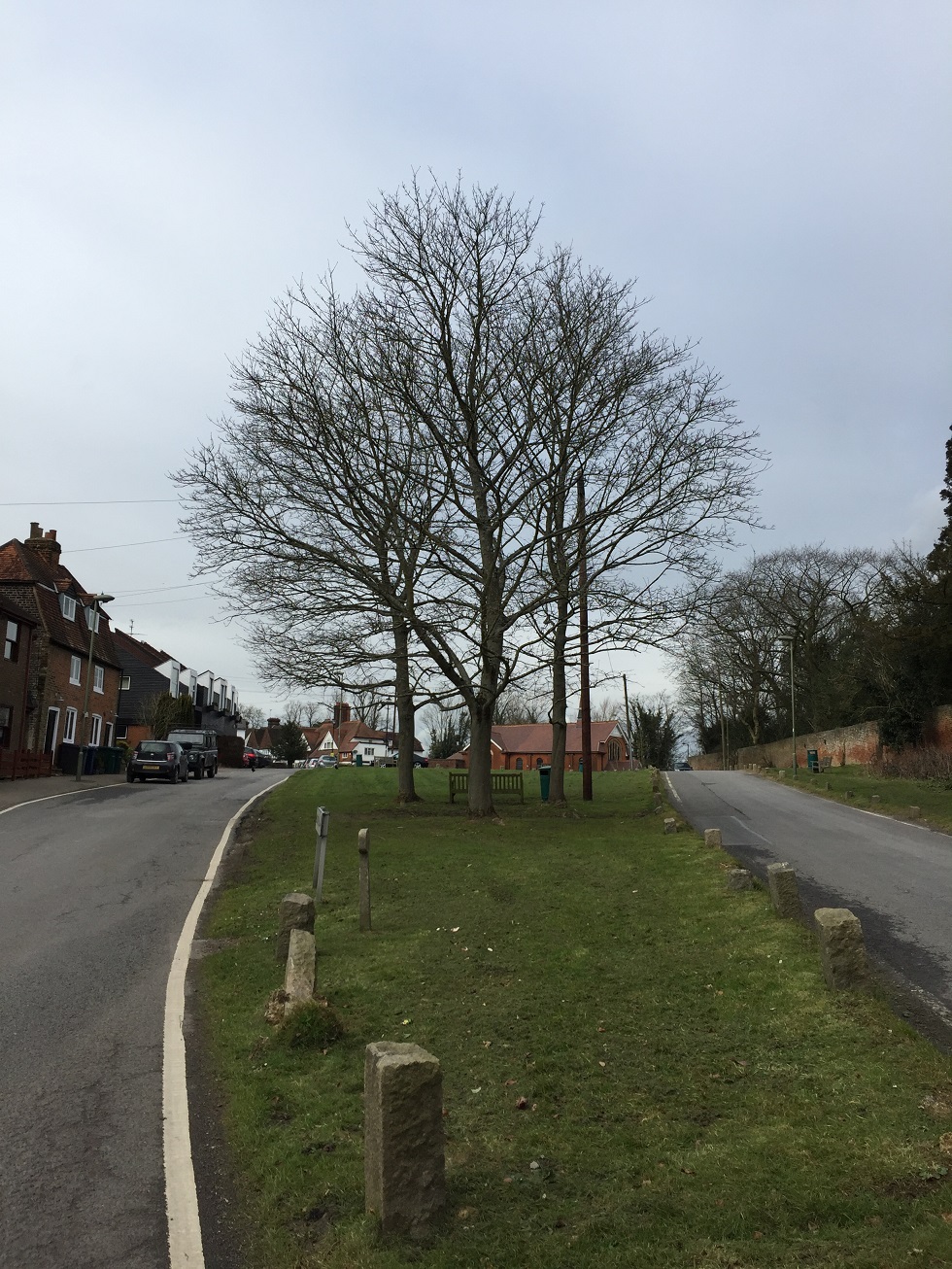
Milespit Hill, Mill Hill

After passing all the mansions on Milespit Hill, I was surprised to see an estate of boarded up flats as the road joined Pursley Road. Whether these are destine for renovation or demolition I could not tell. There seemed to be some behind these that were still occupied, so maybe the former.

Boarded up flats, Pursley Road NW7

Boarded up flats, Pursley Road NW7

Boarded up flats, Pursley Road NW7

Always interested in disused railways, I was delighted to come across the former Mill Hill to Edgware line. The next few pictures show the bridge crossing at Sanders Lane.

Bridge over the former Mill Hill to Edgware branch of the Northern line

Bridge over the former Mill Hill to Edgware branch of the Northern line

And this is the view looking down from the Sanders Road bridge.

The former Mill Hill to Edgware branch of the Northern line

As Sanders Lane came to an end and re-entered into suburbia, I came across this interesting block of flats, or more probably maisonettes, in an otherwise fairly low rise area. What caught my eye was the arches of the stair wells at each end of the block. I think my fascination is possibly also part caused by another recent read, John Grindrod's rather excellent Concretopia: A Journey Around the Rebuilding of Postwar Britain.

Block of flats, Sanders Lane, Mill Hill, London N7

Now the only station on the spur of the northern line, Mill Hill East looks more like a country halt than a tube station.

Mill Hill East station, London N7

As I continued my wander eastwards, my route took me under two bridges which carried the tube line. The first was a fairly standard, green, metal bridge.

Bridge carrying the northern line spur to Mill Hill East, London N7

The second bridge I walked under was of an altogether different size and scale. This is the magnificent Dollis Brook viaduct. I'll apologise now for the number of pictures of the viaduct, but as you can probably tell I was a little blown away by its beauty. The viaduct was designed by John Fowler and Walter Brydone. It has thirteen arches and is the highest part of the London Underground above ground level, at 60 feet.

Dollis Brook Viaduct, Mill Hill East, London N7

Dollis Brook Viaduct, Mill Hill East, London N7

Dollis Brook Viaduct, Mill Hill East, London N7

Everything about this viaduct was spectacular, even the inside. The next two pictures are taken from directly beneath the viaduct, looking through the arches.

Dollis Brook Viaduct, Mill Hill East, London N7

Dollis Brook Viaduct, Mill Hill East, London N7

Dollis Brook Viaduct, Mill Hill East, London N7

Dollis Brook Viaduct, Mill Hill East, London N7

And this is the brook, Dollis Brook, that the viaduct is named after. This whole area forms part of the Dollis Valley Greenwalk, which will be added to my ever increasing list of places to visit. I took this picture though mainly for a different reason as it reminded me of my childhood. I grew up in Ruislip Gardens, not a million miles from Mill Hill, although as I said previously I never ventured here, and this brook brought back memories of the Yeading Brook which we would paddle in and ford across in the long, hot summer holidays of the 1970's.

Dollis Brook, Mill Hill East, London N7

And so another suburban wander comes to an end. This one was immensely enjoyable. I will be back.


Wednesday, 24 February 2016

A Suburban Wander Around Moor Park, Hertfordshire


Inspired by a recent read of Metroland, I ventured out from Baker Street on the Metropolitan line in to the very heart of Metroland, Moor Park. As the tube approached Moor Park, I could feel the transition from the urban to the rural as we headed out through the borderlands of Pinner, through Northwood and Northwood Hills. Leaving the station at Moor Park, it’s hard to believe that this idyllic location is actually on the Underground network, just 15 miles from central London, but in Hertfordshire. This is the view north from the platforms.

The view, looking northwards from Moor Park tube station

And this is one of the relatively low bridges which carries the lines northwards.

Bridge carrying the Metropolitan line north from Moor Park

The station, like many towards the ends of the various tune lines spreading out from the centre, is above ground. The station  building itself is quite small, set on a crescent which seems to double up as a car park for what must be prime commuter territory. I was there around 1pm and whilst it was full of cars, I saw very few people at all. I imagine the rush-hour scene would be somewhat different.

Moor Park tube station

There’s a small parade of shops immediately outside the station, and some relatively modern flats.

Shop parade and flats, Moor Park

And then the houses start. This is the Moor Park Estate, a private residential estate.

Sign for the Moor Park estate

The word houses is perhaps an under-statement … these are what one might prefer to call homes, possibly mansions. These are mostly detached, all set well back from the road in mature gardens. Most of the houses had one, if not more, four wheel drive vehicles parked on their spacious driveways, many with personalised number plates. Most had visible CCTV, which no doubt caught me wandering in amazement.

I could have taken hundreds of pictures of the leafy avenues and magnificent houses, but these are some of my favourite ones. 

Moor Park estate, Hertfordshire

Moor Park estate, Hertfordshire

Moor Park estate, Hertfordshire

Moor Park estate, Hertfordshire

Moor Park estate, Hertfordshire

Moor Park estate, Hertfordshire

Moor Park estate, Hertfordshire

Moor Park estate, Hertfordshire

Moor Park estate, Hertfordshire

The next two pictures are of Main Avenue, the first looking up the hill away from the station, the second looking back down the hill towards the station.

Main Avenue, Moor Park estate, Hertfordshire

Main Avenue, Moor Park estate, Hertfordshire

The whole area was beautifully clean, no doubt kept that way but the estate’s various contractors who I saw as gardeners, builders and security guards. The one piece of litter I did see was, perhaps appropriately, a Waitrose paper cup, and even one small area of dereliction I spotted was neatly fenced off, presumably soon to be transformed into something more fitting for the area.

Behind the shops, Moor Park, Hertfordshire

Moor Park is also featured in John Betjeman’s, still available, wonderful 1973 documentary, Metro-land, as are several other places on my list. Croxley Green and Chorleywood to name but two. I’ve watched this many times and never tire of his commentary and wit.


In other news, I have recently finished reading Concretopia, which despite my kids asking me why I am reading a book about concrete, I have thoroughly enjoyed. It covers the history of the rebuilding of post-war Britain, from the Gorbals in Glasgow, to the new town of Milton Keynes, from Festival Hall to the Barbican. It will certainly make me look at 1950’s buildings, houses and tower blocks with a different eye now.

Wednesday, 20 January 2016

A return Urban Wander around Brackenbury, London W6

From our offices, I frequently used to take lunchtime wanders out towards Brackenbury, which is a residential area of London with a village-like feel, situated near Hammersmith and Ravenscourt Park. When I looked back through the notes from my various urban wanderings, or dérive, I was surprised to see that I had not been here since 2013. With the weather clear, but crisp and cold, I wrapped up warm and headed out.

It never ceases to amaze me that I always spot something new, even on familiar wanders, and this building was no exception. This is a former mission hall, sitting rather curiously in the middle of a row of neat terraced houses, and now home to the John Campbell Scenic Studio.

John Campbell Scenic Studio, former Mission Hall, Iffley Road, London W6

Not far from Iffley Road, although I'm kicking myself now for not noting down the road name, was an unexpected and isolated piece of street art in an otherwise pristine neighbourhood.

Street art, London W6

I took the photo for the combination of chimneys, towers and scaffolding.

Holy Innocents Church, Dorville Crescent, London W6

I'm now wishing I had taken a picture of the full doors rather than just the stained glass windows.

Stained glass windows, Ravenscourt Park Mansions, London W6

And finally on this short drift, a brightly painted bridge carrying the Piccadilly and District lines. I'm always curious about this road and wonder whether the road itself was dropped beneath the level of the houses to allow higher vehicles to pass beneath. 

London Underground railway bridge, near Ravenscourt Park, London W6


Related Posts Plugin for WordPress, Blogger...